
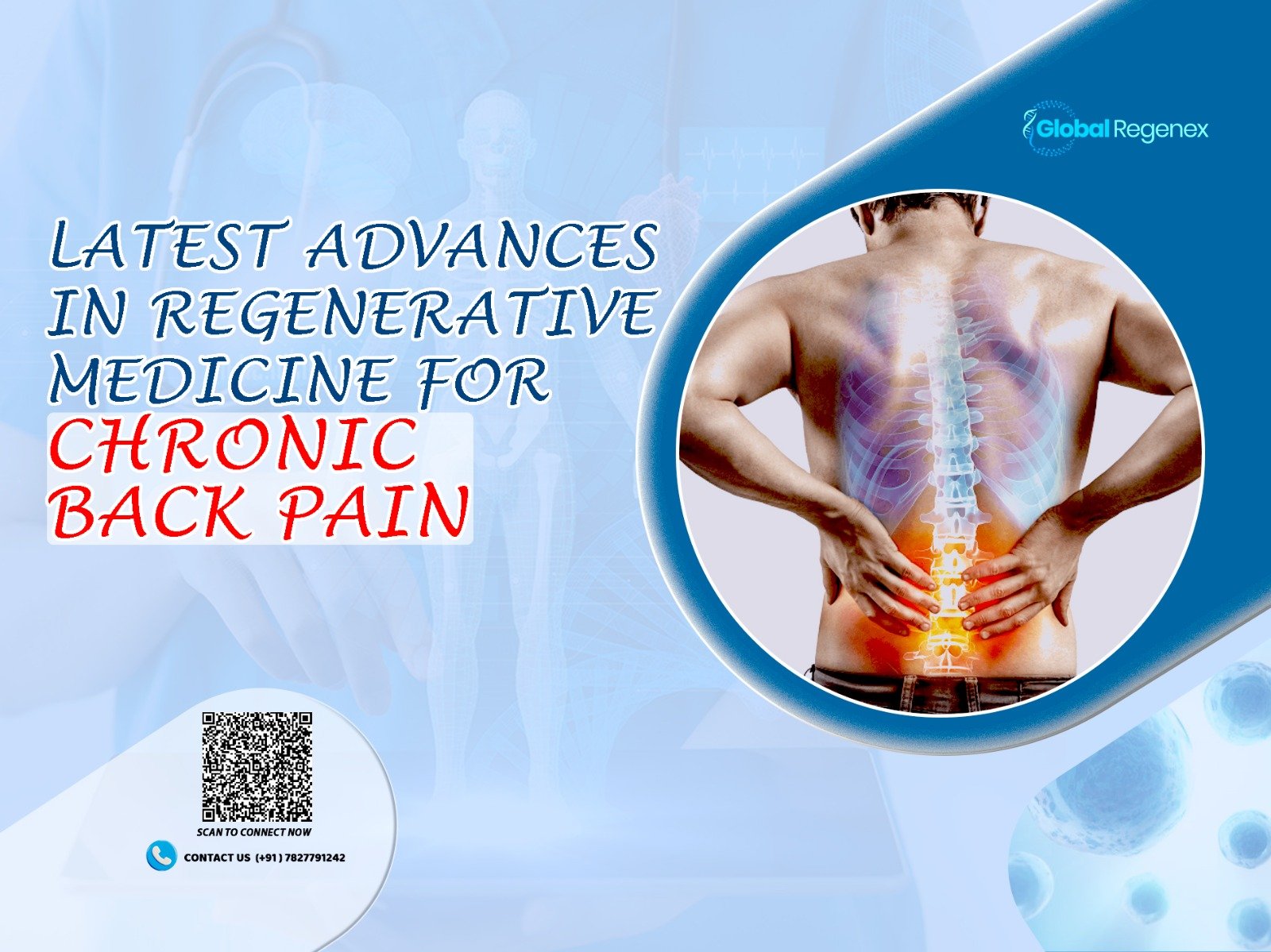
Summary: Learn why regenerative medicine is being explored in research for chronic back pain, how far research has come, what the latest advancements are, and how one can be eligible for the treatment.
Chronic back pain doesn’t have one clear reason. Many people can suffer from chronic back pain for different reasons—whether it is due to injury, posture-related strain, degenerative changes, or more. Over time, it can start to influence your daily movement and work life and even makes hard to sleep.
For many years, the standard treatment method has revolved around pain management and functional improvement by means of physiotherapy, medicines, and even surgeries when necessary. Although all these methods prove effective for many patients, some still investigate new directions such as the regenerative medicine treatment.
As a result, an increasing number of people became interested in exploring how the body’s natural repair mechanisms are studied in research. However, it is also necessary to differentiate between already investigated options and the remaining under research.
Understanding Regenerative Medicine and Its Applications
For patients considering regenerative medicine for back pain, it becomes important to understand how the treatment works before undergoing the procedure. As the idea of regenerative medicine is strongly based on—whether the body can be helped to repair itself rather than just managing the symptoms.
Regarding chronic back pain, this involves investigating the ways that biology affects the reaction to tissue in the back. Rather than addressing the symptom of pain management, the focus is placed on exploring the way the underlying structures, like discs, ligaments, and surrounding tissues, respond over time.
This is one of several techniques under investigation, each at different levels of development, none of which has been established as accepted practice.
The Role of Stem Cells in Back Pain Treatment
The reason why researchers are increasingly studying stem cells for back pain comes from how they may interact with inflammation and tissue response. Instead of concentrating on repairing the damaged parts of the spine, present-day stem cell therapy is more concerned with figuring out whether stem cells have an impact on the environment surrounding injured tissue.
These aspects include their involvement in:
- sending biological signals that may influence healing processes
- participating in inflammation
- influencing the reaction of tissues in the long term
Currently, results have been inconsistent. Some studies have shown promise for certain applications, whereas others have found little efficacy. Inconsistency is one of the factors contributing to the continued research in this field.
PRP Therapy in Chronic Back Pain: What Research Is Exploring
Another part of regenerative medicine is platelet-rich plasma (PRP) therapy, being explored by researchers and practiced in strict clinical settings.
PRP therapy includes the use of substances extracted from the patient’s blood that contain growth factors. They are currently being investigated to establish their ability to help heal various musculoskeletal disorders, such as back pain.
Some areas where PRP is currently under investigation include:
- injuries to soft tissues
- problems related to ligaments
- beginning degeneration
Although some patients claim to have seen some positive results, the effects are not the same for everyone.
Tissue Engineering and Its Impact on Spinal Treatment
As research continues to grow. The focus has shifted beyond just cells to also include their surrounding environment
Tissue engineering deals with how supporting structures, known as scaffolds, can be combined with biological strategies. These supporting structures serve to aid the functioning of the cells and hold them in place.
In the context of spinal studies, the following may be investigated:
- aiding injured disc structures
- promoting tissue stability
- increasing biological interactions in the spine
As noted above, it is an emerging concept that focuses on biological engineering.
The Future of Gene Therapy in Regenerative Medicine
Another area in regenerative medicine that is actively being researched is gene therapy. This therapy involves examining whether a patient’s specific gene can help influence how tissue responds to damage or degeneration. To shine a light on back pain research, the focus is on understanding if these changes can affect inflammation or tissue repair at a deeper level.
Although it remains in its infancy, this marks a departure towards a more focused approach. Most developments in this area are still in the research stage.
Need Expert Advice: Global Regenex
When considering regenerative medicine treatments for chronic back pain, it is very common to receive misleading information because such treatment techniques have been developed recently and require further investigation. In order to understand all the types of their application to your individual case, it is necessary to consider this issue carefully.
Consulting with the team at Global Regenex can help you understand what is relevant based on your condition and current research. This will allow you to be confident in your decision-making process.
The Concluding Thoughts
Chronic back pain often needs a steady, long-term approach to manage rather than one quick solution. While traditional treatment helped manage the symptoms for years—regenerative medicine is now being explored as a developing area of research, but still remains an evolving area rather than evidence-based care.
Being aware of the possibilities as well as the limitations will help in making wise decisions. With proper guidance, individuals can proceed to evaluate promising innovations alongside effective treatments.
Frequently Asked Questions
Q1. Why Does Chronic Back Pain Not Improve Easily In Some Cases?
It is because chronic back pain is often caused by various issues, like disc degeneration, muscle problems, and inflammation. Due to this, the recovery becomes slow and may require a combination of therapies.
Q2. Why Is Regenerative Medicine Different from Conventional Therapies?
Regenerative medicine concentrates on the way the body reacts to the process from a biological perspective, but it is still being investigated and not applied regularly.
Q3. Is PRP Therapy Commonly Used For Chronic Back Pain?
PRP injections are currently being researched for several musculoskeletal conditions, among which is back pain. However, the effectiveness of this method varies significantly.
Q4. Can These Approaches Help Avoid Surgery Completely?
Not yet. Standard treatments, including medication, physiotherapy, and in some cases surgery, remain the primary approach.
Q5. How Do I Know Which Option Is Right For Me?
A proper medical assessment is absolutely necessary. Knowing about yourself and the scientific data will help you determine whether something is indicated or still experimental.
Reference Links
(1) Sakai, D., and Andersson, G. B. J. “Stem Cell Therapy for Intervertebral Disc Regeneration: Current Status and Future Perspectives.” Global Spine Journal, 2019.
https://www.ncbi.nlm.nih.gov/pmc/articles/PMC6626674/
(2) U.S. National Library of Medicine. “Stem Cell Therapy for Degenerative Disc Disease (Clinical Trial Identifier: NCT03347708).” ClinicalTrials.gov, 2018.
https://clinicaltrials.gov/study/NCT03347708
(3) Akeda, K., et al. “Platelet-Rich Plasma (PRP) for the Treatment of Low Back Pain: A Review of Clinical Evidence.” Journal of Orthopaedic Surgery and Research, 2018.
https://www.ncbi.nlm.nih.gov/pmc/articles/PMC6220005/
(4) Binch, A. L. A., et al. “Stem Cell Therapy for Intervertebral Disc Degeneration: Current Challenges and Future Directions.” Stem Cell Research & Therapy, 2021.
Categories
- Alpastic Anemia
- Amyotrophic Lateral Sclerosis
- Articles
- Autoimmune Disease
- Autoimmune Disorders
- Autologous
- Autologous Stem Cell Transplant
- Blog
- blogs
- Bone Marrow
- Bone Marrow Transplants
- Brain Injury
- Cancer Immunotherapy
- Diabetes
- Diabetic
- Exosome Therapy
- Exosomes
- Eye Damage
- Glaucoma
- Hearing Loss
- Immunotherapy
- Joint Replacement
- Kidney
- Knee Injuries
- Lung Cancer
- Lymphoma
- Orthopedic
- Osteoarthritis
- Pancreatic
- Parkinson’s Disease
- PRP
- PRP Treatment
- Regenerate
- Regenerative Medicine
- Spinal Cord
- Stem Cell Therapy
- Stem Cell Therapy for Eye
- Stem Cell Transplants
- Stem cell treatment
- Stem Cell Treatment Patient Stories
- Stroke
- Supplements
- Tourism