
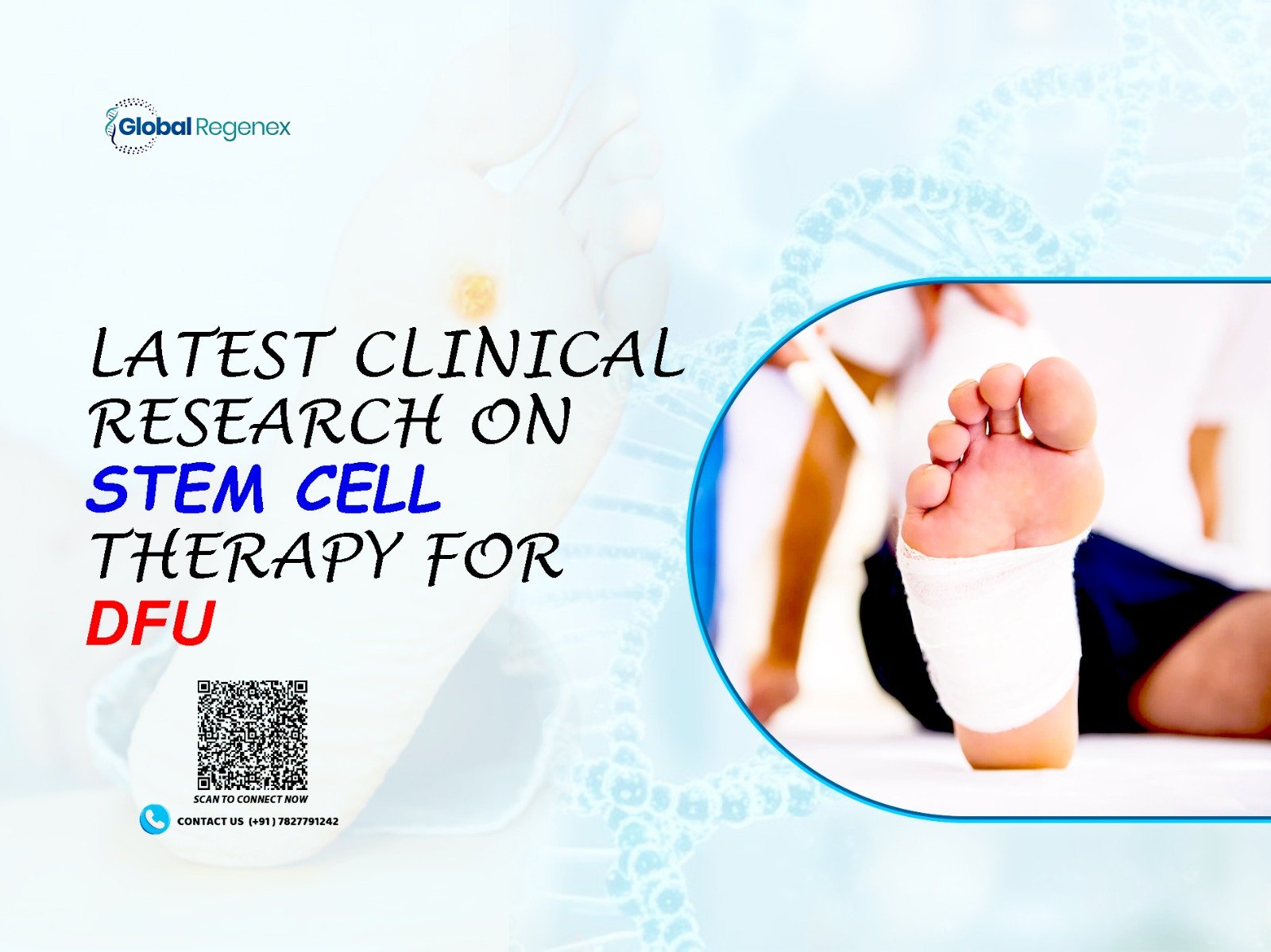
Summary: Discover how stem cell therapy for diabetic foot ulcers (DFU) is being studied in clinical research, what recent findings suggest, and why it remains investigational rather than routine care.
Have you been struggling with a severe diabetic foot ulcer? Dealing with diabetic foot ulcers is one of the most challenging conditions. In some cases, it begins as a small wound that gradually starts to heal slowly, especially when the blood flow starts to weaken, and infection starts to spread, making it a long-term issue for many patients around the world.
Although standard treatment has been used for years for wound care, infection control, and reducing disease progression. Whereas these treatments are necessary, healing can take time. This is the point at which patients look for the use of regenerative medicine, and stem cell technology has become an area of interest, especially when it comes to seeing how these methods can facilitate wound healing.
Understanding Diabetic Foot Ulcers: Causes and Challenges
In simple terms, diabetic foot ulcers develop in patients due to a combination of factors connected to prolonged diabetes.
Some common factors are:
- Reduced blood circulation to the lower limbs
- Nerve damage leading to decreased sensitivity
- Increased susceptibility to infections
- Slower wound healing
Due to reduced sensitivity, patients often fail to recognize small injuries and wounds until they gradually progress enough to turn into a diabetic foot ulcer. That is why managing DFU usually demands persistence, but even then, recovery takes time.
How Stem Cell Therapy Works for DFU
As it core, stem cell therapy is the process where stem cells are injected into a patient’s body, to support and boost the body’s healing system through being studied for their potential role in supporting repair processes and influencing how tissues respond to injury
To shine a light on DFU, the primary purpose of stem cell research involves investigating their potential to provide a new avenue for wound healing. Instead of serving as a therapy in its own right, stem cells have been examined in terms of their potential to:
- Affects the inflammatory response at the site of injury
- Promote angiogenesis
- Interface with tissue repair mechanisms
The goal is to determine if these interactions could create a healing-promoting environment. So far, this is just part of ongoing research that is still under study, not as a practical treatment method.
Recent Clinical Studies on Stem Cell Therapy for DFU
For many patients considering stem cell therapy for their diabetic foot ulcers, they should understand the condition first and learn how the treatment works.
While scientists have done several studies and clinical trials that have explored stem cells for diabetic foot ulcers.
These results include:
- increased ability to close wounds for some patients
- improvement in blood flow to damaged tissues
- a gradual decrease in the size of the wound
However, these results do not consistently appear in all studies. While some have seen little improvement, others recognize the need for more substantial trials.
Understanding these variations is important, as they reflect how therapy is still being evaluated and not confirmed as standard treatment.
Potential Benefits of Stem Cells in DFU Treatment
Before undertaking any treatment, patient often explore how the particular treatment might benefit their condition. In the context of stem cells in DFU treatment, current regenerative medicine research is being explored as a potential benefit.
Here are some areas being explored in research:
- Enhancement of Blood Circulation: Investigations are being conducted to determine whether stem cells can help in the development of new blood vessels.
- Aiding in Tissue Repair: The role of stem cells in helping the body heal naturally is also under investigation.
- Decrease in Inflammation: Certain investigations indicate that stem cells might impact the body’s inflammatory response.
- Change in Wound Healing: In some studies, the wounds exhibited signs of improvement.
These areas might seem promising, but patients should know that these benefits are still in the experimental phase and cannot be guaranteed.
Challenges and Limitations of Stem Cell Therapy for DFU
Though some findings of the study may make patients feel encouraged, it is important to look at certain limitations too.
- Differences in Results: After performing different clinical trials, it is recorded that not all patients respond to treatment in the same way.
- Lack of Long-Term Studies: Due to inconsistent results, more studies and research are required to establish it as a standard treatment.
- Different Protocols Used: Each study uses its unique protocol.
- Specific Patient Characteristics: General health status and wound condition have an impact.
Due to these factors, stem cell therapy for DFU still remains in the research phase.
Need Expert Advice: Global Regenex
When exploring new or investigational options, it is important to first understand where they stand in current medical research.
This is why a proper consultation with an expert is important to determine if your condition can be treated through stem cells or not. Consulting with the experts at Global Regenex will assist you in reviewing your situation more realistically by evaluating which approaches are already proven, which are still being researched, and whether certain approaches are suitable for you or not.
Putting It All Together
Managing diabetic foot ulcers can be complex, especially when healing is delayed or complications develop. Even as stem cell treatment of DFU is being researched under the field of regenerative medicine, it remains at a developmental stage and does not form part of regular treatment procedures.
The patient must be aware of the pros and cons involved. With the correct information, patients can undertake alternative therapies responsibly.
Frequently Asked Questions
Q1. Why Does It Take Longer To Heal DFUs?
The healing process can be slowed down by reduced blood flow, neuropathy, and an increased risk of infections that make healing less effective over time.
Q2. How Are DFUs Different From Other Wounds To Be Treated?
Stem cell therapy research focuses on exploring whether stem cells can influence circulation, inflammation, and tissue repair processes.
Q3. What Does Stem Cell Therapy Research Focus On?
Stem cell therapy research focuses on the possibility of using stem cells to improve circulation, inflammation, and wound healing mechanisms.
Q4. Are All DFU Patients Eligible For Stem Cell Therapy?
Not necessarily, eligibility depends on the patient’s general condition, DFU severity, and other medical considerations.
Q5. What Should Patients Prioritise While Exploring New Treatments?
Patient priority lies in diagnostics, regular wound treatment, and the distinction between evidence-based and experimental therapies.
Reference Links
(1) Daley, G. Q., et al. “Stem Cell Therapy for Diabetic Foot Ulcers: Clinical Evidence.”
Stem Cell Research & Therapy, 2019.
https://pmc.ncbi.nlm.nih.gov/articles/PMC6515323/
(2) Dash, N. R., et al. “Targeting Nonhealing Ulcers of Lower Extremity in Human Through Autologous Bone Marrow–Derived Mesenchymal Stem Cells.”
Stem Cell Research & Therapy, 2019.
https://pmc.ncbi.nlm.nih.gov/articles/PMC6770346/
(3) Li, X., et al. “Stem Cells for Diabetic Foot Ulcer: Current Status and Future Directions.”
Frontiers in Endocrinology, 2020.
https://www.frontiersin.org/articles/10.3389/fendo.2020.00461/full
(4) U.S. National Library of Medicine. “Stem Cell Therapy for Diabetic Foot Ulcers.”
ClinicalTrials.gov, Ongoing.
https://clinicaltrials.gov/search?cond=diabetic+foot+ulcer+stem+cell
(5) Zhang, P., et al. “Advances in Diabetic Foot Ulcer Treatment Using Regenerative Medicine.” Journal of Diabetes Research, 2020.
Categories
- Alpastic Anemia
- Amyotrophic Lateral Sclerosis
- Articles
- Autoimmune Disease
- Autoimmune Disorders
- Autologous
- Autologous Stem Cell Transplant
- Blog
- blogs
- Bone Marrow
- Bone Marrow Transplants
- Brain Injury
- Cancer Immunotherapy
- Diabetes
- Diabetic
- Exosome Therapy
- Exosomes
- Eye Damage
- Glaucoma
- Hearing Loss
- Immunotherapy
- Joint Replacement
- Kidney
- Knee Injuries
- Lung Cancer
- Lymphoma
- Orthopedic
- Osteoarthritis
- Pancreatic
- Parkinson’s Disease
- PRP
- PRP Treatment
- Regenerate
- Regenerative Medicine
- Spinal Cord
- Stem Cell Therapy
- Stem Cell Therapy for Eye
- Stem Cell Transplants
- Stem cell treatment
- Stem Cell Treatment Patient Stories
- Stroke
- Supplements
- Tourism