Table of Contents
Summary: Discover how stem cells can help avoid joint replacement in patients. While joint replacement surgery has been a standard solution for severe damages for a long period of time, stem cells offer a regenerative alternative.
Many people meet an accident about every year, leading to fracture and bone damages that cause severe suffering for life. Whereas a broken joint has been fixed through joint replacement surgery for a long time as a standard treatment. For some, surgery seems like a hard choice to face, which leads patients to explore regenerative ways, such as stem cell therapy.
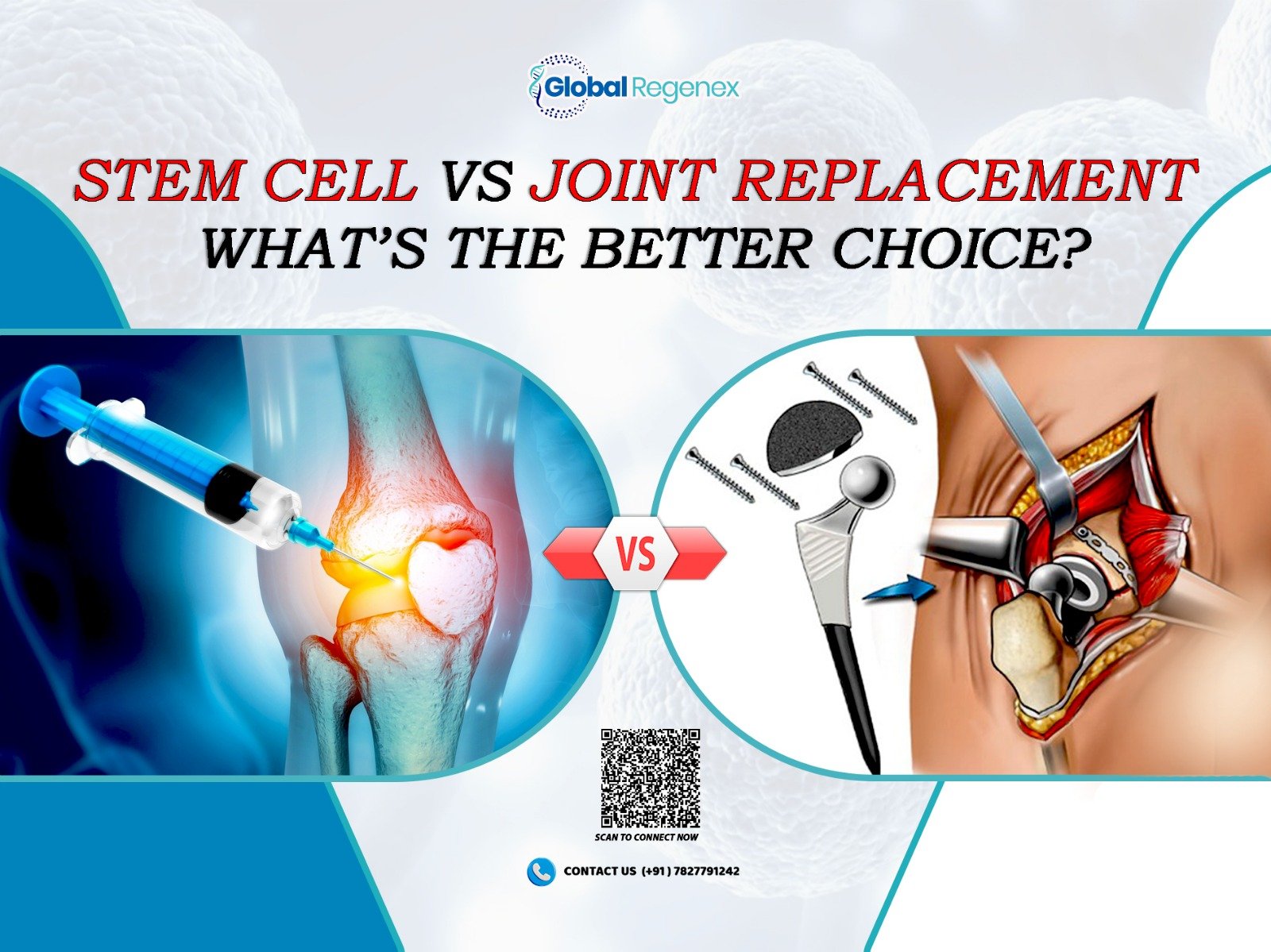
An advanced supportive treatment that uses the potential of stem cells to promote healing through repair and restore functions. So which choice is better for you? The answer often depends on the severity of the condition, age, damage and long-term goal. Let’s explore the real difference to make the right choice.
Understanding Joint Damage
Patient dealing with Joint degeneration usually entails the following:
- Degeneration of the cartilage
- Inflammation of the joint capsule
- Bone rubbing in the late stages
- Loss of mobility and pain
In the early to moderate stages of osteoarthritis, cartilage loss can still be amenable to biological repair. In the late stages, the joint degeneration may be too severe for biological repair.
Common Symptoms of Advanced Joint Damage
Patients with different joint damages experience different symptoms, which help in determining when advanced treatment may be severe:
- Persistent Pain: You might feel a pain that comes and goes at times and worsen over time.
- Stiffness: You may feel stiffness in the joints in the morning or less flexibility in movements.
- Swelling & Inflammation: Your damaged area starts swelling due to irritation or immune system reaction.
- Reduced Range of Motion: Experiencing bone to bone contact or feeling grinding sensation during joint movements.
- Mobility Limitations: You may have trouble walking, climbing or performing daily activities.
What Is Stem Cell Therapy for Joints?
Stem cell treatment is one of the types of regenerative medicine that focus on promoting healing in joints through repair and restoring cells and function. It utilizes the ability of different types of stem cells such as mesenchymal stem cells, often found in bone marrow or fat tissue.
Stem cell therapy helps to:
- Decrease joint inflammation
- Release growth factors for cartilage repair
- Improve the joint micro environment for better functioning
- Slow down the degenerative process
The therapy is quite less invasive and one can be treated at the doctor’s office. The time needed for recovery is also much less than surgery.
Doctors usually suggest stem cell therapy to those who have mild to moderate osteoarthritis and whose cartilage has been damaged but not completely lost.
What Is Joint Replacement Surgery?
Joint replacement surgery is a procedure that involves the removal of damaged cartilage and bone surfaces and their replacement with artificial prosthetic components.
- A major surgical operation under anaesthesia
- Stay at hospital followed by rehabilitation
- Mechanical replacement of the joint surface
- Long term implant durability
Joint replacement is very effective in cases of severe end stage arthritis, especially when there is extensive structural damage or bone on bone contact. Nevertheless, the patient may take several months to fully recover. Besides, as in all surgeries, there are risks of infection, blood clots or the implant wearing out over time.
Stem Cell Therapy vs Joint Replacement: Key Differences
| Factor | Stem Cell Therapy | Joint Replacement |
| Procedure Type | It is minimally invasive process | Majorly surgical operational |
| Recovery Time | Shorter recovery time | Several months rehabilitation |
| Primary Goal | It reduces inflammation and support repair | It replace damaged joint surfaces |
| Suitable For | Early-moderated degeneration | Severe end-stage arthritis |
| Risk | Usually lower surgical risk | Surgical & implant-related risk |
What Does It Mean for the Patients?
As you have understood the differences between stem cell therapy and joint replacement surgery, but still confused about which is suitable for you. Although there is no universal answer but depends on the following factors.
- Severity of degeneration
- Imaging results
- Age and activity level
- Overall health condition
- Long-term functional goals
As regenerative medicine continues to evolve, careful evaluation is necessary. Talking to regenerative medicine experts can help you understand the current research and if this treatment is suitable for you. Consulting with Global Regenex, helps patients understand the treatment, evaluate the condition, and connects patients with top healthcares.
Putting It All Together
Joint replacement surgery is still the most effective method for significantly damaged joints. On the other hand, stem cell therapy is a regenerative method that is less traumatic and can help postpone surgery for certain patients. Both options are under constant research, thus, deciding between them should be a matter of personal evaluation. Global Regenex helps patients decide suitable treatment for their condition and connects with best healthcares.
Frequently Asked Questions
Q1. Is stem cell therapy more effective than joint replacement?
Ans. Which one is better depends on how bad the disease is. Stem cell therapy may be a good option to treat very early arthritis while joint replacement is better for very advanced arthritis.
Q2. Can stem cells regrow cartilage completely?
Ans. Currently, the studies support the idea that there may be a beneficial effect on cartilage regeneration but the full regeneration is not always supported.
Q3. How long will a joint replacement be effective?
Ans. The average life span of a prosthetic joint, after which it is expected to function properly, is 15 to 20 years, depending on the lifestyle and health of the patient.
Q4. Is stem cell therapy safer than surgery?
Ans. Yes, stem cell therapy is non-invasive, however the effectiveness of the treatment is still in research.
Q5. Can stem cell therapy delay joint replacement?
Ans. Yes, patients with moderate arthritis can be treated with stem cell therapy to alleviate their symptoms, and the joint replacement surgery can be postponed.
Reference Links
National Institute of Arthritis and Musculoskeletal and Skin Diseases – Osteoarthritis Overview
https://www.niams.nih.gov/health-topics/osteoarthritis
PubMed Central – Mesenchymal Stem Cells in Osteoarthritis Treatment
https://www.ncbi.nlm.nih.gov/pmc/articles/PMC6605747/
American Academy of Orthopaedic Surgeons – Total Joint Replacement
https://orthoinfo.aaos.org/en/treatment/total-joint-replacement/
International Society for Stem Cell Research – Clinical Guidelines
https://www.isscr.org/policy/guidelines-for-stem-cell-research-and-clinical-translation